

Source: Freepik
Electronic music holds a significant presence in today’s market. Whether it’s the tunes you hear on the radio, television or the Internet, electronic music elements can be found in a vast array of genres.
As an aspiring electronic music producer, this fact is truly exciting and motivates you to delve into the world of electronic music creation. The chance to gain a substantial following is within reach once you successfully produce captivating electronic music.
However, producing captivating electronic music isn’t as easy as it seems. It takes a lot of hard work and dedication to keep experimenting with your tracks until you produce one that you are proud of.
In this guide, we’ll cover everything you need to know about how to produce electronic music for beginners, including consideration to join music course. Keep on reading and embark on your journey of becoming an electronic music producer with ease!
Getting Started: An Overview of Electronic Music
Electronic music is a genre of music that entails artificial instruments, digital technologies, and computer-based techniques for its creation. It differs from acoustic music that relies on the organic sounds of traditional instruments like guitar, piano, drum and more.
Electronic music also has a unique characteristic compared to other genres of music. It often features repetitive beats and synthesised backing tracks that work together creating a sonic landscape for the listeners.
The repetitive beats serve as the rhythmic foundation that entices listeners to move through the music. On the other hand, the synthesised backing track provides a wide arrange of sound designs and textures, which the producers can experiment with in their music.
There is a broad range of electronic music styles, each with its characteristic and sound that you can experiment with depending on your choice. Some notable styles include techno, progressive house, dubstep, and many more.
However, what’s truly fascinating is the popularity of electronic music crossing over with other genres such as pop, jazz, and rock, among other genres. The intersection of electronic music with diverse genres has contributed to its ever-growing popularity in recent times.
Even bands known for genres other than EDM, such as Coldplay, Bring Me The Horizon, and Linkin Park, are now broadening their musical horizons by adding electronic elements to their songs.
What To Prepare Before Creating Electronic Music For Beginners?
Before immersing yourself in electronic music creation, it’s essential to have all the necessary preparations beforehand. Enough preparation will help you navigate through the process of producing electronic tracks, with minimised obstacles due to a lack of readiness.
To set yourself up for success in electronic music production, consider the following:
Invest in The Essential Gear
Investing in the essential gear ensures that you can create electronic music with the right tools and equipment. Below are some of the gear that you need to invest in before you can start producing your electronic music, starting with a computer, DAW, plugins, and more.
Computer
Since you’ll be spending a lot of time working on your tracks digitally, a supporting computer is the first thing that you need to invest in. The specs you need may differ depending on the software you intend to use and how you are going to run the software.
Aside from that, choosing the right computer will also depend on your budget. We’ll break down our recommendation based on budget-wise below.
- Budget computer: If you’re on a tight budget, a computer with a minimum Core i5 2.6GHz (6 cores) CPU, 8GB RAM, 500GB SSD storage, and a 1680 x 1050 monitor will suffice for basic audio production.
- Comfortable computer: If you’re willing to spend more money on a computer, consider getting one with a Core i7 2.5GHz (8 cores) CPU, 16GB RAM, 500GB SSD + 1TB HDD storage, and 1920 x 1080 (Full HD) monitor to run audio production software more smoothly.
- High-end computer: A high-end computer with a minimum Core i7 2.8GHz (10 cores) CPU, 32GB RAM, 1TB SSD + 2TB HDD storage, and a 3840×2160 (4K UHD) monitor makes a powerful choice for running audio production software.
Digital Audio Workstation (DAW)
A digital audio workstation (DAW) is the place where you’ll be working on your tracks. There are vast options of available DAW which you can choose from, depending on your preferences such as Logic Pro, Ableton Live, and FL Studio.
Many beginner music producers are perplexed about which DAW is best for them. No DAW is superior to the others because using one over the other does not affect the quality of the tracks.
The key is to find the one with the most user-friendly interface to help you navigate its features. Consider using a demo version first before purchasing it to ensure that you prefer that particular DAW.
Plugins
Plugins or virtual instruments refer to software components that integrate with a DAW to provide additional functionality and processing capabilities. There are a variety of plugins that serve different purposes, as listed below:
- Virtual instruments: These plugins emulate traditional instruments like synthesisers, pianos, drums, bass, and more. These plugins can be played through a MIDI controller, which will be discussed later.
- Effects plugins: These plugins modify the audio signal by either adding creative or corrective treatments to enhance the sound. These plugins often include reverb, delay, EQ, compression, distortion, and many others.
- Mixing and mastering plugins: These plugins help in achieving a balanced mix, improving clarity, and optimising sound for different playback systems.
MIDI Controller
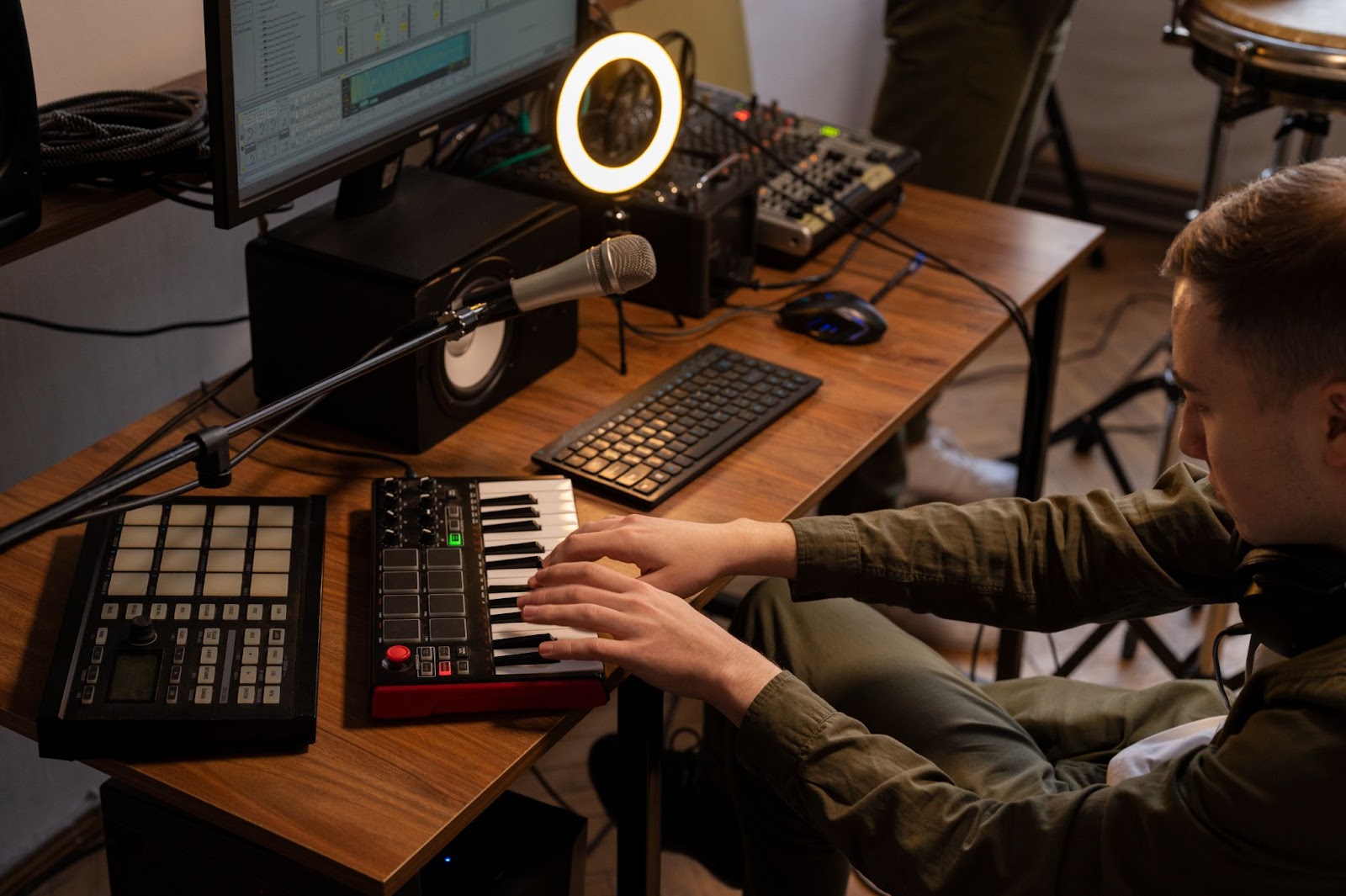
A MIDI controller is a device used to send and receive MIDI (Musical Instrument Digital Interface) data to and from a computer. It comes in a variety of forms, including a keyboard, drum pads, and knob controllers.
Playing virtual instruments, controlling parameters, or manipulating various aspects that exist within a DAW can be done with this device. When you press a key on it, it will send MIDI messages to your computer, instructing the DAW to correspond with a specific action.
Studio Headphones
Studio headphones are a type of headphones specifically designed for professional audio monitoring and music production purposes. They are built to provide accurate and transparent sound reproduction, allowing you to make more precise audio mix decisions.
Additionally, studio headphones have an excellent noise isolation feature. They are designed with a closed-back and over-the-ear design, allowing less outside noise to interfere with your audio monitoring process.
Nowadays, there is a vast selection of studio headphones available. As a beginner, you may start with a budget pair that costs around $30 to $70 and progress to more professional options that cost $150 or more.
Microphone
A microphone is a device used to record sound waves. In the context of electronic music production, you can use a microphone to capture vocals and other sounds that can then be processed digitally to enhance your electronic tracks.
For example, you can record your voice and then import it into the DAW for further processing. Aside from that, you can use objects to make sounds and record them with a microphone to be edited in the DAW.
There are a wide variety of microphones available in the market. If you’re just starting, it may be unnecessary to invest in a high-end microphone. Going with a budget option will suffice.
Audio Interface
An audio interface is a hardware device that connects your external audio equipment like headphones and microphones to your computer. It provides high-quality signal conversion, ensuring accurate audio signals playback and recording.
Starting with a budget audio interface makes a great choice if you’re just starting. There are a variety of options available that cost $100 or below. Just ensure that the one you choose meets the bare minimum requirements.
Comprehend Sound Design and Music Theory
Sound design and music theory are two fundamental aspects of electronic music production. Having a solid comprehension of these basics significantly affects your creative process and the overall quality of the track you produce. You may consider to take the relevant music course to help you with it.
In the following, we’ll delve into more details on sound design and music theory:
Sound Design
Sound design is the art of creating and manipulating sounds to achieve the expected sonic landscape. It involves using a variety of tools, techniques, and synthesis methods to shape and craft sounds that fit the desired aesthetic and emotions.
By understanding sound design, you can create unique sound elements to improve your electronic music with. The unique sound elements bring your music to life and make it more enticing for everyone to listen.
Music Theory
Music theory refers to the principles that govern the composition of music. Without music theory, the instruments will have no structure and sound unappealing to the listeners.
In terms of music production, you don’t necessarily have to master playing musical instruments, but you need to comprehend the following elements:
- Melody: Melody consists of individual notes arranged in a sequence to produce pleasing musical sounds. The majority of musical compositions contain multiple repeating melodies.
- Harmony: Harmony is a combination of multiple notes playing at the same time and sound pleasing. Examples of harmony include chord and chord progression that exist to complement the melody.
- Rhythms: Rhythms involve the repeating pattern of sounds. In music, rhythms serve as the time perception that helps organise and drive the music forward. They give a sense of groove, energy, and movement within a composition.
Eventually, by having a solid understanding of music theory, it will be easier for you to produce electronic music, as you can:
- Build chord progressions and melodies easier
- Achieve the desired expression and emotion in your tracks
- Make more informed decisions on your composition
- Improve your critical listening skills
How To Produce Music For Beginners: Steps-by-steps To Create Your Electronic Music
With all the preparations at hand, now is the time to dive into the exciting part of creating your electronic music.
In the following, we’ll break down the essential elements and techniques on how to produce music for beginners, including electronic tracks. Follow along and unlock your creativity with these tried-and-true methods!
- First Thing First: Ask Yourself, What Kind of Electronic Music Do You Want To Create?
The first thing you should do is decide what kind of electronic music you want to make. There are broad styles of electronic music, such as techno, progressive house, dubstep, and more. You can start with one that resonates with your personal preferences first.
Once you’ve made your decision, it will be easier to progress to the next steps. This first step allows you to envision the sound elements required for the specific electronic music style that you choose.
Generally, each electronic music style has its characteristics, making them different from one another and capturing different target audiences. Below we’ll provide brief descriptions of famous electronic music styles:
- Techno
Techno is characterised by its repetitive beats, driving rhythms, and a focus on the exploration of sound textures. It often incorporates synthetic sounds, intricate percussion patterns, and evolving arrangements that create hypnotic and energetic experiences.
As time went by, techno expanded into a subgenre known as minimal techno. Minimal techno is a simpler form of techno distinguished by heavy repetition and subtle chord progressions.
If techno or minimal techno is an electronic music style that you’ll be happy to produce, try to listen to Stephan Bodzin, Peggy Gou, or Carl Cox. Listening to well-known techno artists will broaden your references and help you to be more creative.
- Progressive House:
Progressive House is famous for its focus on melodies and vocals. It also has a gradual progression of elements throughout the track, resulting in a sound that is both energetic and emotionally uplifting.
This particular electronic music style has been rising in popularity nowadays. Some famous artists are producing this subgenre of house music that you may be familiar with, such as Marshmello, deadmau5, and Martin Garrix.
- Dubstep:
Dubstep is an electronic music style distinguished by its heavy basslines, syncopated rhythms, and intricate sound design. This results in a unique sense of groove and energy, along with immersive sonic experiences.
This electronic music style that emerged in the early 90s remains popular nowadays. Several artists are famous for playing dubstep, including Skrillex, Knife Party, Jack Ü, and many more.
- Start Experimenting
After deciding on the electronic music style, it’s your time to start experimenting. There is no better way to learn music production than by making your first piece of electronic tunes. It doesn’t matter if the result is flawed because you’ll improve along the way.
But, to make the experiment process easier, you can consider the following advice:
Anchor Your Music Production on Music Theory
Music theory which includes melody, harmony, and rhythms is very helpful in the process of music production. The set of rules helps you make chord progressions easily and understand whether you’re creating good or bad sounds.
Aside from that, music theory opens up more possibilities to enrich the elements within your music. You can create a distinct and enjoyable sonic palette in your composition by having a solid understanding of music theory.
Spice Up Your Music with Sound Design
Sound design involves creating, adding, and modifying sounds for the matter of your musical composition. The sounds exist to make your compositions more enjoyable and captivating to listeners.
You can make the sounds from scratch by using virtual instruments, consisting of bass, drums, piano, and more. These virtual instruments can be played using a MIDI controller connected to plugins. But as a beginner, you can also use downloadable and royalty-free samples.
Examples of websites that provide downloadable and royalty-free samples are Splice, Loopmasters, Soundcamp, and many others. After downloading the samples, you can work through them however you want via your DAW.
Add Vocals to Your Music
Electronic music transcends the constraints of electronic instruments. A vast number of popular electronic tracks, both past and present, contain vocal elements.
For this reason, you may consider adding vocals to your musical composition. Despite being optional, the presence of vocal elements gives a humanistic feel to your electronic music, elevating its emotional impact and resonance.
There are two main methods you can do to add vocal elements to your electronic tracks. The first is by recording your voice using a microphone. This allows you to infuse your music with a personal touch and bring your unique expression to the forefront.
Second, you can also use samples to blend vocals into your electronic music. These samples are obtainable through sound libraries or collaborations with vocalists. Once you have the samples, you can adjust them to match your desired style by using a DAW.
Embrace Your Curiosity
When it comes to music production, the opportunity to create truly unique compositions is endless. To fully capitalise on these abundant opportunities, you must embrace your curiosity wholeheartedly and maintain an unrestrained thirst for exploration.
This is particularly true for electronic music, which is known for its non-linear structure. Remaining curious opens up a world of possibilities, providing a fertile ground for experimentation and innovation.
- Arrange Your Tracks
Once you have created individual instruments or vocal tracks, it’s time to bring them together and arrange your music. This essential step involves structuring your composition, organising different sections, and ensuring a smooth and coherent flow throughout the track.
The arrangement process typically includes the following elements:
- Intro: Start your composition with a catchy intro that sets the mood for the rest of the song.
- Verse and Chorus: Continue to set up the verse, which is the song’s foundation, as well as the chorus, which is the song’s most memorable part.
- Builds Up and Drops: Build-ups, which usually consist of verses and choruses, are used to increase the tension of your song before adding drops that intensify the mood.
- Outro: Finish your composition by providing a sense of closure. You can use the fade-out effect to leave a lasting impression on listeners.
It’s important to note that arrangement is a purely creative process with no strict rules. It’s especially true with electronic music that allows for experimentation and non-linear structure.
However, following some basic rules of arrangement can be beneficial to maintain a cohesive flow. By adhering to these rules, the final product will be more harmonious and evokes pleasing effects to the listeners.
- Polish Your Tracks Through Mixing
Once you have arranged your tracks, it’s time to refine and enhance the sonic quality of your music through mixing. This part of the audio post-production stage is important for achieving a professional and polished sound.
Audio mixing is the art of combining tracks from different instruments, such as drums, bass, vocals and more. You need to adeptly blend them to achieve a balanced mix in which all of the instruments are present at the desired levels.
Mixing should always start with careful listening by using speakers and studio headphones. This allows you to assess every instrument within your composition and make more informed decisions during the process.
- Upload Your Music Online
Now is the time to upload your music to the internet after you’ve finished producing and editing it. Uploading your music online gives your music a wider audience outside of your friends and family. This allows you to gain feedback, which can help you improve.
If you wonder how to produce your music online, you can consider uploading your music to open-source sites like Soundcloud or Funkwhale. The open-source music platforms have a simpler procedure for uploading music, which is suitable for beginners.
On the other hand, if you’re willing to go beyond, you can start uploading music to digital platforms like Spotify, Apple Music, Deezer, and more. Learn more about producing your music online through this article specifically talking about digital music distribution.
From Beginner to Expert: How to Get Into a Professional Music Producer?
Becoming a professional music producer takes a lot of effort and dedication. The journey involves starting with imperfect tracks and progressing towards creating high-quality music that resonates with a wider audience.
But you can speed up the process by joining a specialised music course. A Diploma in Electronic Music Production and Sound Design is worth your consideration to embark on your journey to become a professional electronic music producer in the future.
The program is equipped with a meticulous curriculum and guided by mentors with vast experience in the electronic music field. This will ensure that you receive the necessary knowledge along with the practical skills to become an expert yourself.
Final Thoughts
The answer to the question ‘how to produce electronic music for beginners’ is a willingness to dedicate time and effort to continuing to experiment with electronic music production.
When you first start experimenting with electronic music production, your tracks may sound imperfect. However, this shouldn’t discourage you from continuing to learn and improve your skills until you can finally produce music that you are proud of.
Ensure that you have the right resources for your learning journey, which you can achieve from a Diploma in Electronic Music Production and Sound Design at Asian Screen Institute music course.
The programme is specifically designed to equip you with the right knowledge and skills to become a professional in the field of electronic music production. This allows you to gain relevant insights and guidance as you embark on your journey to your dream career.
Contact us for more information.
FAQs
Is making EDM music easy?
Making EDM music requires a lot of effort and dedication. But, it can be a more streamlined process if you understand the framework, which can be achieved effectively by enrolling for a Diploma in Electronic Music Production and Sound Design.
How do I start making music for beginners?
Starting to make music for beginners requires curiosity and willingness to learn. Aside from that, you can start investing in the necessary skills and equipment to support your experiment.
What programs make electronic music?
There are a wide variety of programs to make electronic music. But the main programme to use is a digital audio workstation (DAW). DAW itself comes in a variety of brands, including Logic Pro, Ableton Live, or FL Studio, which you can choose from depending on your preferences.


